

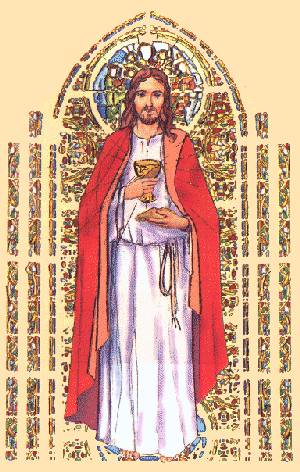
I did not decide to write the book [Bloodline of the Holy Grail]. The book happened by accident, not by design. It happened by virtue of the fact that for about the last ten years I have been the appointed historian and sovereign genealogist to thirty-three royal families. It happened because during those early periods I was documenting evidence on the history of those royal families and their noble offshoots, and the chivalric archives of those noble and sovereign families.
What I was doing was putting together written chronological accounts of things that these families knew the substance of but did not necessarily know the detail of. It is the reason why in Britain and Europe I necessarily spend far less time on this biblical aspect, because there's a lot of what we'll talk about tonight that in Europe is taken as read. It was never any secret when my book came out, for the majority of these people, that Jesus was married and that Jesus had heirs, because it was
written as such in very many family archives, not necessarily just private but in the open domain. The published papers of Mary, Queen of Scots talk about it at length. The papers of James II of England, who was wasn't deposed until 1688, talk of it at length.
In putting together the detail, generation by generation, of this story, we were actually compiling something for posterity that, at that point in time when I began the work, was locked away in boxes and cupboards, and I was actually in a position where I was presented with things and said, "Look, this says, 'Last opened in 1732!". So, some very, very old documentation, not only last opened in seventeen-whenever, but actually documented and written down hundreds of years before that.
The book happened by accident. Over a period of time-probably, looking back now, ten or twelve years ago-I began this work with separate commissions from separate families, doing work on these genealogies. What happened was they began to converge. It became very apparent-and it took a long time because genealogies have to be done backwards, put together backwards and constructed backwards-but what was happening was that a triangle, from a large top base with numerous family lines, was pulling in to a point.
I suddenly realised what this point was, and I said, "Wow, do you
realise what I've found here?"; and they said, "Ah, you know the father of so and so?"; and I said, "No, no, no; I'm actually finding that this comes out of the House of Judah in the first century"; and they said, "Oh, yeah, we know all that; what we wanted you to do was for you..."; and I said, "Well, there are millions of people out there who do not know about it, so let's turn this triangle upside down and turn it into a book!". So that's how the book happened.
On top of that, for the last six years I have been Britain's Grand Prior of the Sacred Kindred of Saint Columba, the royal ecclesiastical seat of the Celtic Church. So I had, also, access to Celtic Church records dating back to AD 37. Because of my attachments to the families, to the knightly orders, I also had access to Templar documents, to the very documents that the Knights Templar brought out in Europe in 1128 and confronted the Church establishment with, and frightened the life out of
them with, because these were documents that talked about bloodline and genealogy, and we'll get on to that.
Quests are by their very nature intriguing; history and historical research are enlightening; but the findings from neither are of any use whatsoever unless there are present-day applications which, like science and medicine, can sow the seeds of a better future.
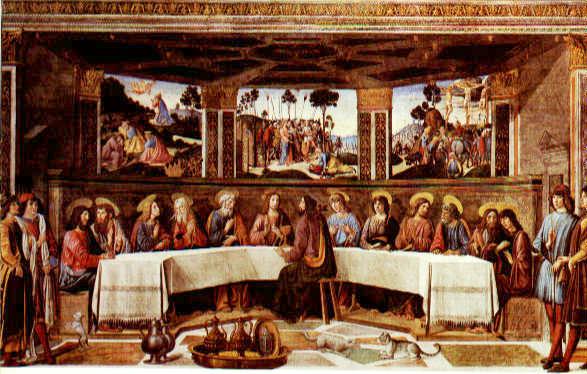
History is no more than recorded experience-generally, the experience of its winners. It makes common sense to learn from the experience of yesterday. It's that very experience which holds the moral, cultural, political, social keys of tomorrow, and it's in this context that the Holy Grail supports that which we call "the Messianic Code". This is the code of social practice instituted by Jesus when he washed his apostles' feet at the Last Supper. It pertains to the obligations of giving and receiving service; it determines that those in positions of elected
authority and influence should always be aware of their duties as
representatives of society, obligated to serve society, not to presume authority over society. It is the essential key to democratic government. This is defined as government by the people, for the people. Without the implementation of the Grail Code, we experience the only-too-familiar government of the people. This is not democratic government.
So our quest will begin in the Holy Land of Judaea in the time of Jesus and we'll spend a good while there. I will not move from that era until we break, because it will take that long to set the emergent scene for the next 2,000 years of history.
Bloodline of the Holy Grail, the book, has been described as "the book of messianic descent". It was a radio interviewer who called it that; and it's an apt description because the book carries the subtitle, The Hidden Lineage of Jesus Revealed. This of course indicates that Jesus had children and, by implication therefore, that he was married. So was he married? Did Jesus have children? If so, do we know what happened to them? Are there descendants alive today? The answer to each of these questions is yes. We shall be looking at the emergent family in some detail. We will follow the story, their story, century by century; the story of a resolute royal dynasty, the descendant heirs of Jesus who struggled against all odds through the centuries to preserve the
Messianic Royal Code down to date.
Tonight's story will be a conspiracy: usurped crowns, pursecutions, assassinations, and the unwarranted concealment of information from the people of the Western world. It's an account of good government and bad government; about how the patriarchal kingship of people was supplanted by dogmatic tyranny and the dictatorial lordship of lands. It's a compelling journey of discovery, a view of past ages, but with its eye firmly set on the future. This is history as it was once written but has
never been told.
Let's begin with the most obvious of all questions. What is the Holy Grail? How is the Holy Grail connected with the descendant heirs of Jesus? The fact that Jesus had descendants might come as a surprise to some, but it was widely known in Britain and Europe until the late Middle Ages, just a few hundred years ago.
In mediaeval times, the line of messianic descent was defined by the French word Sangréal. This derived from the two words, Sang Réal, meaning "Blood Royal". This was the Blood Royal of Judah, the kingly line of David which progressed through Jesus and his heirs. In English translation, the definition, Sangréal, became "San Gréal", as in "San" Francisco. When written more fully it was written "Saint Grail", "Saint", of course, relating to "Holy"; and by a natural linguistic process came the more romantically familiar name, "Holy Grail".
From the Middle Ages there were a number of chivalric and military orders specifically attached to the Messianic Blood Royal in Britain and Europe. They included the Order of the Realm of Sion, the Order of the Sacred Sepulchre; but the most prestigious of all was the Sovereign Order of the Sangréal-the Knights of the Holy Grail. This was a dynastic Order of Scotland's Royal House of Stewart.
It is quite apparent that although maintaining the ancient Communion custom, the Christian Church has conveniently ignored and elected not to teach the true meaning and origin of that custom. Few people even think to enquire about the ultimate symbolism of the chalice and wine sacrament, believing that it comes simply from some gospel entry relating to the Last Supper. Well, it's the significance of the perpetual blood of Jesus. How is the blood of Jesus, or anyone else for that matter, perpetuated? It is perpetuated through family and lineage.
So why was it that the Church authorities elected to ignore the
bloodline significance of the Grail sacrament? They kept the sacrament. Why was it they went so far as to denounce Grail lore and Grail symbolism as heretical?
The fact is that every government and every church teaches the form of history or dogma most conducive to its own vested interest. In this regard we're all conditioned to receiving a very selective form of teaching. We are taught what we're supposed to know, and we are told what we're supposed to believe. But for the most part we learn both political and religious history by way of national or clerical propaganda, and this often becomes absolute dogma, teachings which may not be challenged for fear of reprisals.
With regard to the Church's attitude towards the chalice and the wine, it is blatantly apparent that the original symbolism had to be reinterpreted by the bishops because it denoted that Jesus had offspring and therefore that he must have united with a woman.
But it was not only sacraments and customary ritual that were
reinterpreted because of this: the very gospels themselves were
corrupted to comply with the male-only establishment of the Church of Rome-much like a modern film editor will adjust and select the tapes to achieve the desired result, the result of the vested interest of the film-maker.
We're all familiar with the gospels of Matthew, Mark, Luke and John, but what about the other gospels? What about the Gospel of Philip, of Thomas, of Mary and of Mary Magdalene? What of all the numerous gospels and acts and epistles that were not approved by the Church councils when the New Testament was collated? Why were they excluded when the choices were made?
There were actually two main criteria for selection of gospels for the New Testament. These were determined at the Council of Carthage in the year 397. The first criterion was that the New Testament must be written in the names of Jesus' own apostles. Mark was not an apostle of Jesus, as far as we know; nor was Luke. They were colleagues of the later St Paul. Thomas, on the other hand, was one of the original twelve, and yet the gospel in his name was excluded. Not only that, but along with numerous other gospels and texts it was destined and sentenced to be
destroyed.
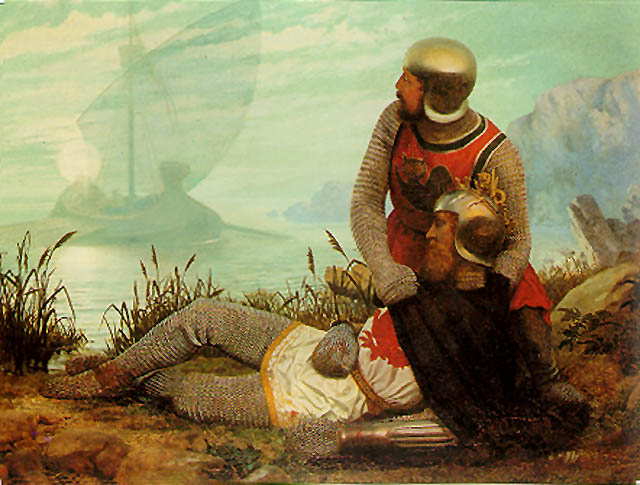
So tonight we're going to embark on a time-honoured quest. Some have called it the ultimate quest. The Christian Church has condemned it as a heresy, and it is, of course, the quest for the Holy Grail.
A heresy is described in all dictionaries as "an opinion which is
contrary to the orthodox dogma of the Christian bishops", and, in this regard, those other quests which comprise much of today's scientific and medical research are equally heretical. The word "heresy" is, in essence, nothing more than a derogatory label, a tag used by a fearful Church establishment that has long sought to maintain control of society through fear of the unknown. A heresy can therefore define those aspects of philosophy, research, which quest into the realms of the unknown, and
which from time to time provide answers and solutions that are quite contrary to Church doctrine.
Now, in the course of our journey we'll be discussing many items which are thoroughly familiar, but we'll be looking at them from a different perspective to that normally conveyed. In this regard it will appear that we are often treading wholly new ground, but in fact it was only the ground that existed before it was carpeted and concealed by those with otherwise vested interests. Only by rolling back this carpet of purposeful concealment can we succeed in our quest for the Holy Grail.
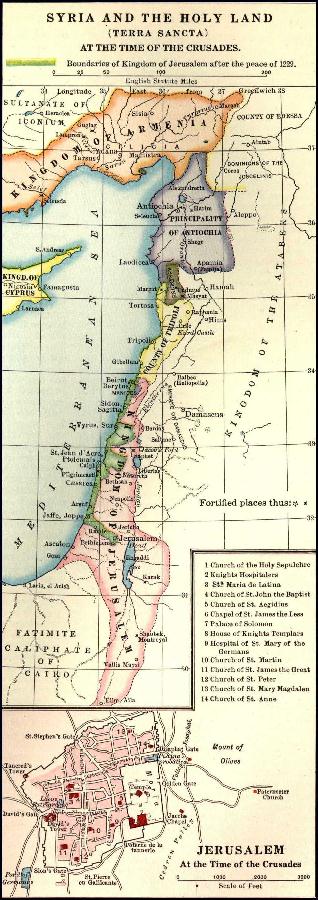
We'll be travelling through the Dark Ages then, to spend some time in mediaeval Europe. The Grail mystery will then be followed into King Arthur's Britain and, eventually, in time, to the United States of America where the American fathers were among the greatest exponents of the Grail Code. Eminent Americans such as George Washington, John Adams, Benjamin Franklin, Charles Thompson, Thomas Jefferson were as much champions of the Holy Grail as were King Arthur, Sir Lancelot and Galahad.
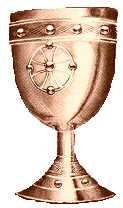
In symbolic terms the Grail is often portrayed as a chalice that
contains the blood of Jesus; alternatively as a vine of grapes. The product of grapes is wine, and it is the chalice and the wine of Grail tradition that sit at the very heart of the Communion, the Mass, the Eucharist; and this sacrament, the Sacred Chalice, contains the wine that represents the perpetual blood of Jesus.
